

Kein Mensch ist eine Insel, in sich ganz Rebekka Benzenberg, Pascale Birchler, Laurel Nakadate Opening 22nd November 2026, 4 pm KunstHaus Potsdam
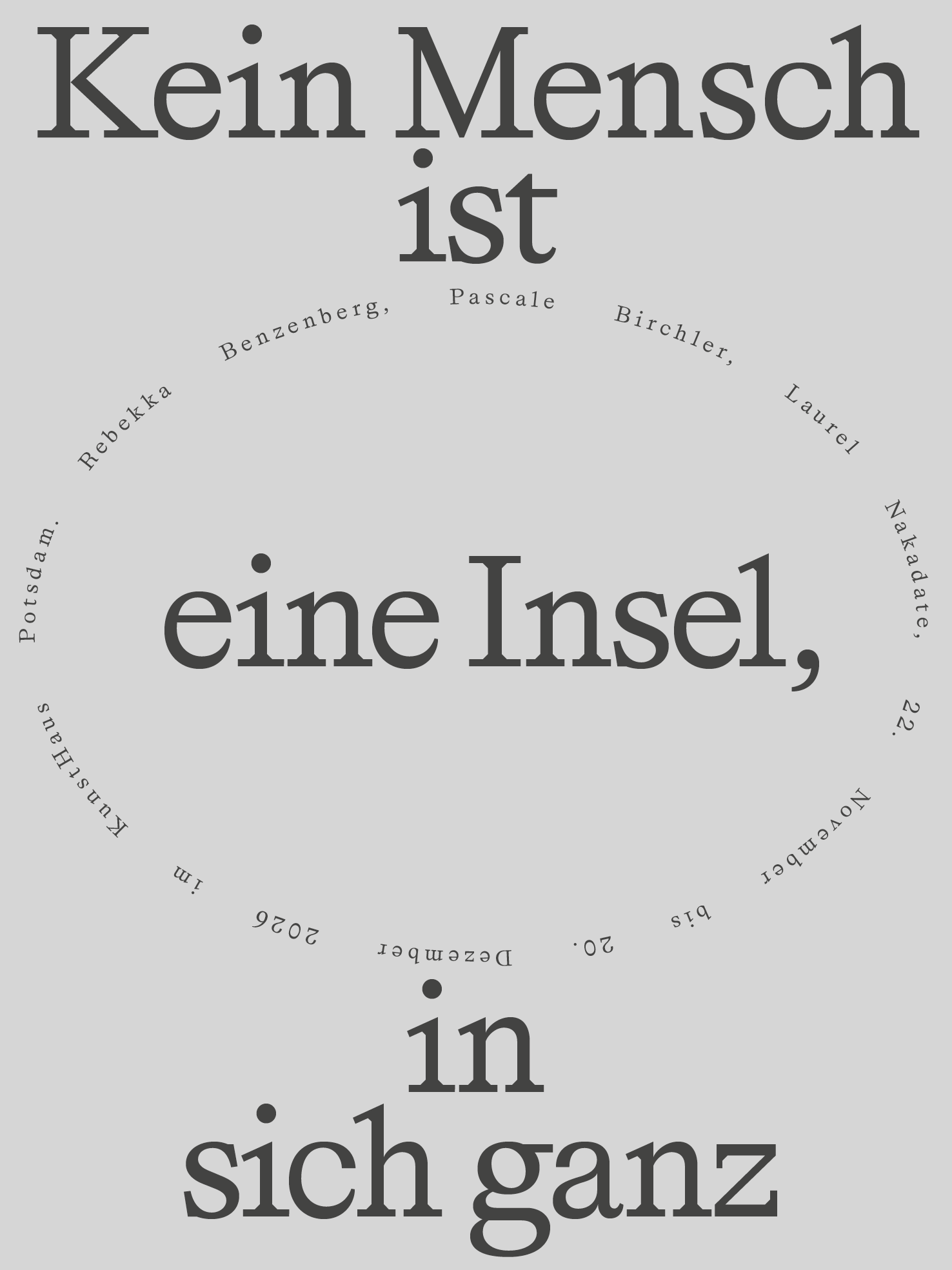
‘No man is an island, entire of itself’ is a line from Devotions upon Emergent Occasions, published in 1624 by the English writer John Donne. It describes every human being as part of the mainland. If the sea washes away even a piece of land, the mainland becomes smaller. In this image, the loss of one person is a loss for us all. Even when we feel lonely, we remain part of a shared world; a thought that carries a sense of hope.
For a long time, solitude was associated with voluntary withdrawal, peace and contemplation. This understanding began to change in the nineteenth century. With industrialisation, the growth of cities and increasing individualism, loneliness began to be more commonly discussed as a social problem in Europe and the United States. Social isolation and the loss of familiar ties were seen as defining experiences of the twentieth century. This is reflected, for example, in stereotypical figures familiar from consumer culture and advertising such as the lonely cowboy or the tough single woman.
Over the past 50 years, the social sciences have sought to examine loneliness more closely and draw a clearer distinction between loneliness and being alone: being alone describes an external condition, while loneliness is the distressing sense of lacking social connection. Studies suggest that this feeling has become significantly more widespread over the past 20 years. Older people (34.4% of those over 65) and young adults (28.7% of those aged 25–34) are particularly affected.
Today, in the twenty-first century, we increasingly hear accounts of young people who feel left behind and abandoned by society. This seems paradoxical, given that this generation is more interconnected than any before it. Can this feeling be explained by the general sense of crisis in recent years, shaped by the pandemic, wars and recession? Is increasing immersion in the digital realm one of the causes? Or do stress and illness push us into unwanted isolation? Loneliness can also arise in later life, for example when people close to us die, everyday journeys become more difficult or we lack the financial means to participate in social life.
The exhibition Kein Mensch ist eine Insel, in sich ganz (No man is an island, entire of itself) considers the extent to which loneliness is a symptom of our time. Three artists, Rebekka Benzenberg, Pascale Birchler and Laurel Nakadate, each explore different aspects of loneliness. Their works address loneliness within family relationships, explore mental illness and consider how we negotiate our relationship with what we call the world.
Rebekka Benzenberg (b. 1990 in Duisburg, Germany) lives and works in Berlin and Düsseldorf. Her practice encompasses sculpture, installation, painting, video and sound. She examines how social power relations shape representations of female bodies and how misogynistic ideas persist in images to this day.
In the exhibition, the artist explores the effects of exhaustion in the context of everyday life shaped by the pressure to perform and social media. The bed, as a place of retreat, becomes an intimate starting point for considering how people experience and cope with depression.
Pascale Birchler (b. 1982 in Zug, Switzerland) lives and works in Zurich. Her installations combine sculpture, drawing and painting. She creates theatrical settings that link personal experiences and questions with associations drawn from the history of art and culture. In this way, she examines how closeness develops and how loneliness can be experienced even in the presence of another person. Pascale Birchler’s works create moments that oscillate between unbridled strength and profound emptiness.
Laurel Nakadate (b. 1975 in Austin, Texas, USA) lives and works in New York City. She works with photography, video, film and performance. In her early videos, she uses chance encounters with strangers as a starting point for shared performances, appearing on camera herself. The question of how images create a sense of closeness and shape our perception of relationships links these works to her later photographic series exploring her own family history.
In the works on display, Laurel Nakadate combines family photographs from different periods to create images of an encounter that never took place.
Kein Mensch ist eine Insel, in sich ganz
Rebekka Benzenberg, Pascale Birchler, Laurel Nakadate
Duration
23 November – 20 December 2026
Opening
22 November 2026, 4 pm
Curated by
Undine Rietz & Alexander Pütz
Venue
KunstHaus Potsdam
Ulanenweg 9
14469 Potsdam
Programme
29 November, 4 pm
Curators’ Tour
3 December, 6 pm
Lecture: Dr. Michael Homberg
10 December, 6 pm
Artist’s Talk: Pascale Birchler
13 December, 3 pm
Festive afternoon: coffee and cake
with Silbernetz e.V.
Design
Onck West
Funded by
))